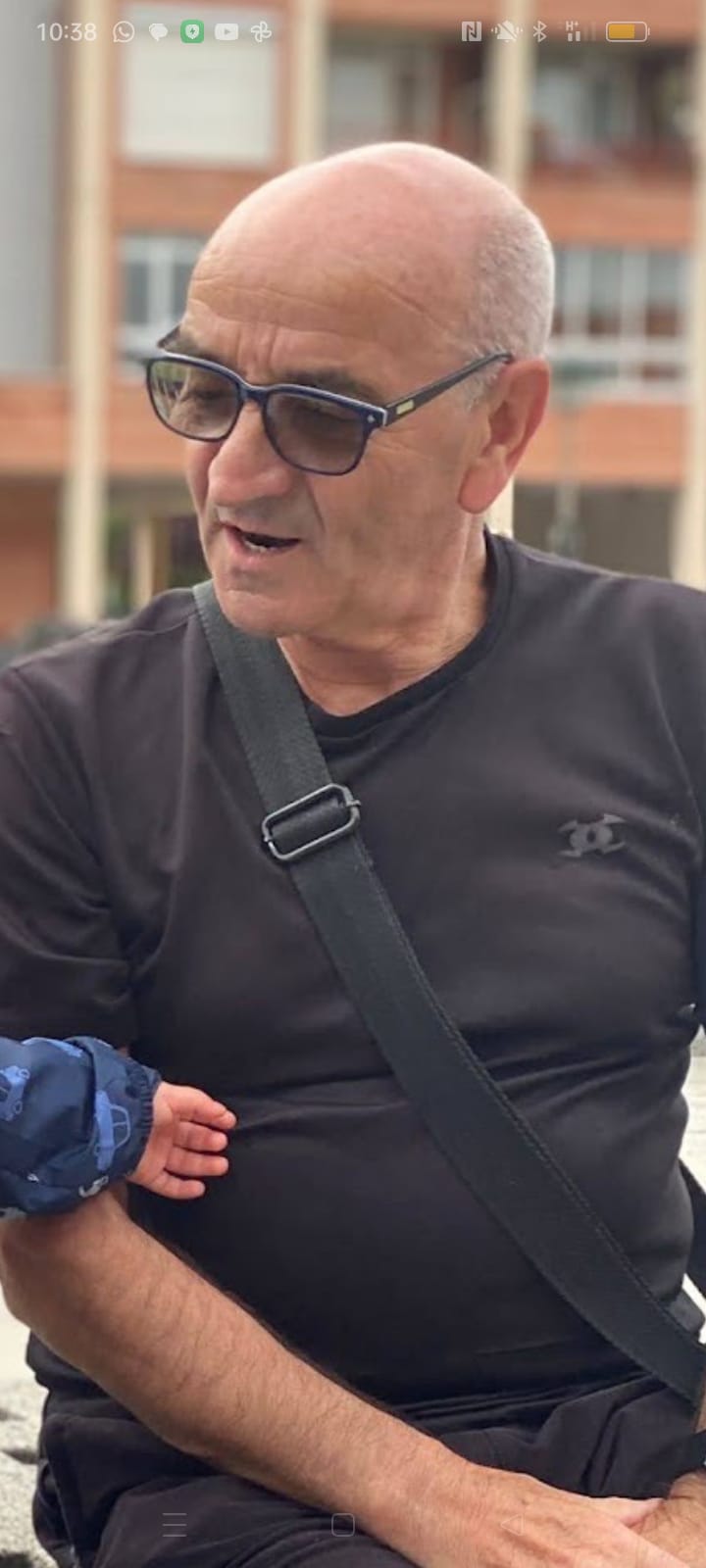
Andrés Dámaso Arenas Romero was 72 years old. He had worked all his life: he built his home, raised his children, passed on his values, loved without conditions. In his final years, life presented him with two diagnoses that needed him: advanced Alzheimer's and Multiple Sclerosis. Both progressed without mercy. Both were irreversible.
Who Andrés was — an exemplary man
Andrés was a true worker. Not in word, but in deed. He fulfilled all his obligations: fiscal, family, social. He was fair. He never asked for more than what was owed to him. He never stole or deceived. In a word: he was honest.
He taught his children music, judo, Eastern philosophy. He taught them to be in the mountains, to build fires, to find their way. He taught them patience, presence, respect. He didn't teach them to game the system — he taught them to be better people. And it worked: they raised their own children with those same values.
Andrés found balance in life. He was not a rebel. He was not a troublemaker. He was what the system should reward: a man who worked, who fulfilled his duties, who passed on his values, who never asked for anything he didn't deserve.
And despite that, the administration never gave him support when he needed it.
A man like this, who was exemplary his whole life, who paid his taxes, who raised his children right — was abandoned by a system that supposedly exists to protect those who cannot protect themselves.
That is what hurts the most. Not that he fell ill. Not that he grew old. But that as everything grew darker, the administration — which knew exactly who he was, what he needed, and why he needed it — decided to look away.
What happened next is not a story of illness — it is a story of how an administrative system, with all the information available, decided to ignore it.
Two years ago
About two years ago, Andrés's family began asking for help. The requests were formal, repeated, documented. A primary caregiver — his wife, with 67% recognized disability — was trying to care for a man who needed round-the-clock attention. Their two children could not help: one had his own work and family responsibilities; the other was the full-time primary caregiver for an 8-year-old child with Down syndrome and 67% disability.
The situation was clear. The family communicated it to the public authorities in every possible tone: formal, urgent, desperate. The paperwork multiplied. Medical reports piled up. Requests for review of the dependency rating were sent again and again.
The response was always the same: "it's in process." The ratings on record remained the ones from years earlier, when Andrés's clinical condition was less severe. But in the administration, paperwork doesn't age — it simply gets filed away.
The caregiver's collapse
About two months before the end, the caregiver — Andrés's wife — broke down. It wasn't a decision. It was a fact: a woman with 67% disability, after years of absorbing everything without professional support, reached the point where her body could no longer cope. It was medically certified. It was irreversible.
The administration already knew. The family had already said it a hundred times. But in the administrative file, this remained just one more allegation, without urgency, without weight.
Andrés was admitted to Araba University Hospital. After 15 days, he was transferred to a URSS (Socio-Health Recovery Unit) — a temporary resource, in theory, while a permanent residential place was assigned.
That place was never assigned.
The incomprehensible
The Elderly Assessment Committee ruled that Andrés was fit to be discharged from the URSS on 27 July 2026, to return to the family home.
How is this possible?
Two years of requests. A thousand administrative and medical reports. A caregiver with 67% disability who had already broken down. Two children unable to take on the care. A clinical condition requiring round-the-clock professional attention. And still: "discharge home." As if none of the above existed. As if the administration's own records were fiction.
This is not negligence in the classic sense. Negligence implies a lack of attention. Here there was attention — paperwork, procedures, records. But that attention was oriented toward closing files, not toward solving reality.
The final days
Less than 24 hours between the urgent request and death. The one thing administrative networks cannot avoid is the timeline.
What you see when you look
This is the part that hurts the most: the system saw what was happening. It wasn't blindness. It was deliberate disregard.
- • They saw that there were two irreversible progressive diagnoses.
- • They saw that the primary caregiver was a woman with 67% disability.
- • They saw that the children could not take on the care.
- • They saw that the family had asked for help a hundred times.
- • They saw that the caregiver had broken down.
- • And they decided everything was fine. That discharge home was "reasonable."
This is not a protocol error. It is a lack of coherence between what is known and what is done. It is a system more concerned with closing files than with keeping alive the human beings those files represent.
What needs to change?
This is not about more laws. It is not about more protocols. It is about returning to the humanity that got lost somewhere between paperwork and bureaucracy.
It's about ensuring that when a doctor, a social worker, or any committee reads that a caregiver has 67% disability and has broken down, they do NOT say everything is fine. It's about making coherence an administrative virtue, not an exception.
It's about families who ask for help — genuinely, desperately — being heard before it's too late. Not with "kind words." With action.
It's about seeing Andrés — not as a case number, not as an administrative problem — but as a man who deserved better options than the ones he was given.
The healthcare staff who did understand
In the midst of all this, there were those who understood without needing words: the medical staff of Araba University Hospital, the nurses, the professionals who saw Andrés every day.
They didn't need a hundred documents to understand that a person with advanced Alzheimer's and Multiple Sclerosis cannot go back home. They didn't need paperwork to see that a caregiver with 67% disability had broken down. They saw, they understood, they acted with professionalism and dignity.
To you, healthcare workers, our gratitude. Because in the middle of a dehumanized system, you kept humanity alive. Because without saying almost anything, everything was said.
The social workers: puppets of a system that doesn't work
The social workers arrived with "kind words." Very nice, very empathetic, very available for a chat. But when the moment came to actually solve something — to act, to change something, to push the system from within — they disappeared.
Not because they were bad people. But because they are puppets. Agents of a system that has tamed them. Bureaucrats who administer poverty, dependency, and suffering as if it were a matter of correctly filled-out forms.
Effective at solving things? Zero.
How many times did they say "we'll see"? How many times did they offer to "help"? And when the family needed them to actually do something — review the assessment, speed up the process, push administratively — what happened?
Nothing. Silence. More paperwork. More "in process."
And then, once it becomes clear the public system isn't going to solve it, they tell you — without saying it outright — "figure it out yourself." Solve it privately. Pay. Hire private caregivers. It's your problem, not ours.
That's what the social services system does: it channels suffering toward the private sector. It doesn't solve. It deflects. And it washes its hands with smiles and courteous treatment.
To you, social workers reading this: it is not your fault that the system is this way. But you are complicit as long as you allow it. You could push from within. You could make things work. But it's easier to be nice and solve nothing.
Dehumanization
The word that defines all of this is dehumanization. It is not malice. It is the logic of a system that has forgotten that behind every case file there is a family that weeps, a body that ages, a life that fades away.
When the system speaks "kind words" but acts to serve itself, it dehumanizes. When it receives a hundred requests and responds with administrative silence, it dehumanizes. When a committee makes a decision that contradicts all the evidence the system itself has documented, it dehumanizes.
"Institutional indifference is the purest form of cruelty, because it needs no knife. It only needs paperwork."
For those who recognize their own story
If you are reading this, and you see the story of your grandfather, your father, your mother, your partner in what happened to Andrés — I want you to know you are not alone. That the system failing you now is the same one that has failed a hundred times before. That "kind words" without action are just words.
That asking for help and being ignored hurts. That fighting the administration while your loved one is dying is a form of torture the system does not recognize as such.
That Andrés deserved more. Your family deserves more. We all deserve a system that is coherent: that tells the truth and honors it.
Andrés is gone. But his story remains here. So that others may see what happened. So that others don't have to suffer the same thing. So that, one day, the administration remembers it manages lives, not paperwork.
Sign the petition
We're asking the Provincial Council of Álava and the Basque Government for urgent coordination protocols in dependency care, so no family has to go through what ours did.
Sign on Change.org →Every signature counts
Eskerrik asko, aita. Your legacy is this truth.
Alma de blues
Andrés loved the blues. It was his language when words weren't enough. Because the blues understands pain without needing to explain it. The blues knows injustice, struggle, dignity in adversity.
That's why this testimony ends with the song that sums up everything Andrés was, what he deserved, and what the system failed to understand:
Alma de blues
Presuntos Implicados
Find it on your favorite platform and let the blues carry you.
Spotify • YouTube • Apple Music • Deezer
Because while the system closes its files, the blues remains the only truth that matters.